Character Archetypes: 12 Types, Examples and How to Make an OC
By Nayan Dhabarde · Published October 11, 2026
A character archetype is a type of character that shows up across stories and cultures and that readers recognize at once: the Hero, the Mentor, the Trickster, the Rebel. Writers start from an archetype because it gives a character a clear job and a clear drive. Then they add specific traits, a flaw and a history until the character stops being a type and becomes a person.
Below are the 12 archetypes most writing guides use, the 8 story roles from Christopher Vogler, anime and villain archetypes, and step-by-step ways to create a character or an OC from one.
Jump to: What an archetype is · The 12 archetypes · OC ideas per archetype · 8 story roles · Anime archetypes · Villain archetypes · Avoiding clichés · How to create a character · How to make an OC · How to create an anime character · FAQ
What is a character archetype?
The idea comes from psychology. Jungian psychology treats archetypes as "innate patterns of thought and behavior" that everyone shares, and Carl Jung wrote about figures such as the shadow, the wise old man, the child and the trickster (Wikipedia).
Storytellers took it from there. Joseph Campbell's The Hero with a Thousand Faces (1949) traced one shared hero's story through myths from around the world (Wikipedia). Christopher Vogler, a Hollywood writer and producer, turned Campbell's book into a seven-page studio memo and later into The Writer's Journey, which names eight archetypes by the job each one does in a plot (Wikipedia).
Three terms get mixed up a lot. Wikipedia's article on stock characters puts it plainly: "these terms are not synonyms" (Wikipedia).
| Term | What it is | Example |
|---|---|---|
| Archetype | A broad type found in stories everywhere | The Mentor |
| Stock character | A narrower, familiar version of a type, usually tied to a genre | The detective one week from retirement |
| Stereotype or cliché | A stock character used with nothing added | The old wizard who exists only to explain the plot, then die |
An archetype is a starting point. The work of writing a character is everything you add after it.
The 12 character archetypes
The list of twelve that most writing guides use grew out of Jung's ideas by way of branding. Carol S. Pearson wrote about twelve archetypes in Awakening the Heroes Within (1991), then co-wrote The Hero and the Outlaw (2001), a book about building brands on archetypes, with Margaret Mark (Wikipedia). Names vary between sources: the Everyman is also called the Regular Guy or the Orphan, the Rebel is the Outlaw, the Jester is the Fool, and the Explorer is the Seeker.
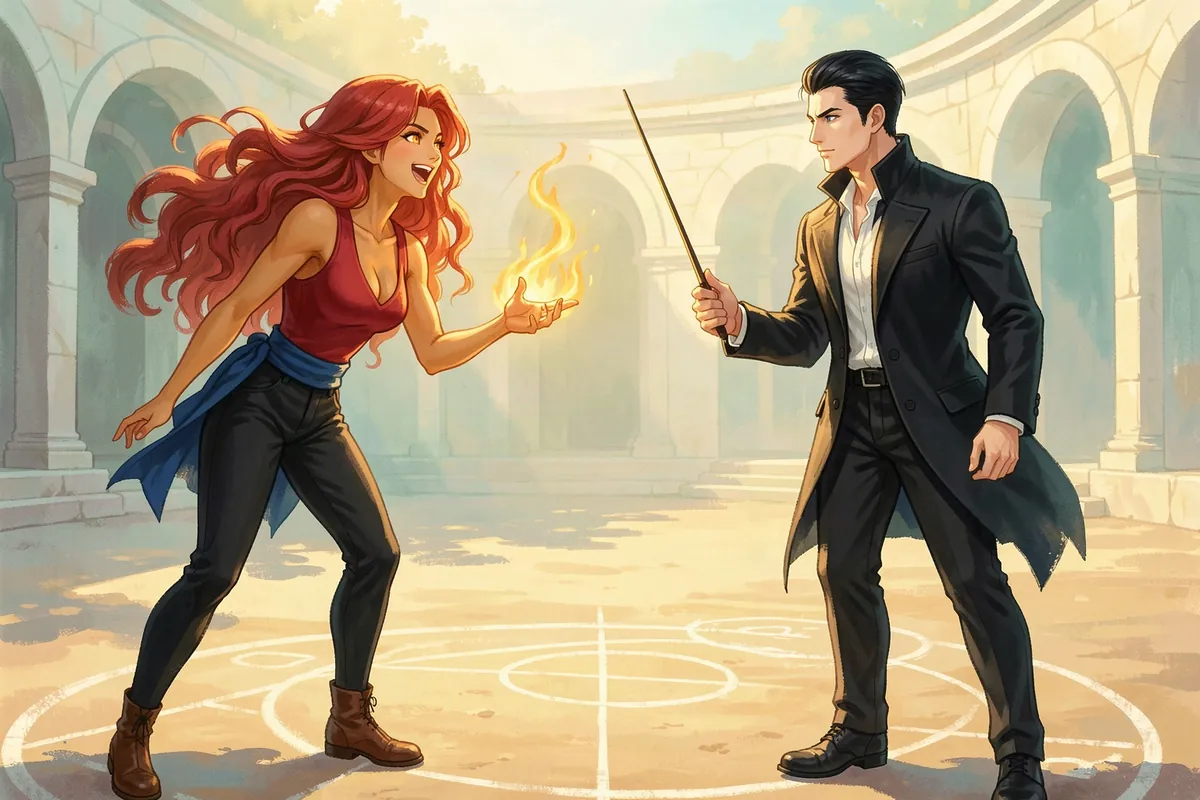
Ines Calder and Kael Ashgrave in Solenne's training yard, drawn in the world's art style. She plays like a Hero, he plays like a Ruler, and that makes them natural rivals.
| Archetype | Wants | Fears | Strength | Trap | Classic examples |
|---|---|---|---|---|---|
| Innocent | To be happy and do right | Doing wrong and being punished | Faith, optimism | Naive, easy to fool | Forrest Gump, Paddington Bear |
| Everyman | To belong | Standing out or being left out | Down to earth, easy to relate to | Fades into the crowd | Bilbo Baggins, Arthur Dent |
| Hero | To prove their worth through courage | Weakness, cowardice | Courage, skill | Arrogance, needing a fight to matter | Luke Skywalker, Katniss Everdeen |
| Caregiver | To protect and help others | Selfishness, ingratitude | Compassion, generosity | Martyrdom, being used | Samwise Gamgee, Molly Weasley |
| Explorer | Freedom to see what's out there | Being trapped, fitting in | Curiosity, independence | Never settling anywhere | Indiana Jones, Moana |
| Rebel | To overturn what isn't working | Being powerless | Daring, freedom | Sliding into crime or cruelty | Robin Hood, Lisbeth Salander |
| Lover | Closeness and connection | Being alone and unwanted | Passion, devotion | Losing themselves in someone else | Romeo and Juliet, Jack Dawson in Titanic |
| Creator | To make something that lasts | Mediocrity | Imagination, vision | Perfectionism | Victor Frankenstein, Willy Wonka |
| Jester | To enjoy life and make others laugh | Boredom, being dull | Joy, wit | Never serious when it matters | The Genie in Aladdin, Fred and George Weasley |
| Sage | The truth | Being fooled, ignorance | Wisdom, insight | Studying forever, acting never | Gandalf, Yoda |
| Magician | To change how things are | Consequences they didn't foresee | Transformation | Manipulating people | Prospero in The Tempest, Doctor Strange |
| Ruler | Order and control | Chaos, being overthrown | Leadership, responsibility | Tyranny | Mufasa, Tywin Lannister |
Most memorable characters mix two. Samwise is a Caregiver who becomes a Hero. Tywin is a Ruler whose trap has already closed.
One OC idea for each archetype
Each idea below keeps the archetype's want and fear but puts them somewhere you haven't seen them. Steal any of them. There are 160 more in our OC ideas list.
| Archetype | OC idea |
|---|---|
| Innocent | A temple novice who believes every promise, because in her village oaths were binding by law |
| Everyman | A bakery delivery boy who walks into the chosen one's prophecy by mistake and is too polite to leave |
| Hero | A champion duelist who has never lost and has no idea who she is if she does |
| Caregiver | A retired army medic who patches up the town's monsters, because no one else will |
| Explorer | A mapmaker who keeps mapping the same valley because it keeps changing |
| Rebel | A noble's daughter who robs her own family's tax wagons |
| Lover | A hired letter-writer who falls for the person he writes to on a client's behalf |
| Creator | A clockmaker building a mechanical bird to replace the one her brother lost |
| Jester | A court fool, the only person allowed to tell the queen the truth, who is running out of jokes |
| Sage | An archivist who knows every rank the academy ever granted except the one somebody erased |
| Magician | A hedge-witch who can change one thing about anyone, once, and can never undo it |
| Ruler | A sixteen-year-old heir pretending he knows how to run the city his father lost at cards |
Vogler's 8 story role archetypes
The twelve above describe what a character wants. Vogler's eight describe what a character does for the plot. The Writer's Journey lists the Hero, Mentor, Threshold Guardian, Herald, Shapeshifter, Shadow, Ally and Trickster (Wikipedia). One book shows all eight:
| Role | Job in the plot | In Harry Potter and the Sorcerer's Stone |
|---|---|---|
| Hero | Wants something, changes, pays a price for it | Harry |
| Mentor | Teaches, protects, hands over a gift | Dumbledore, who passes on the Invisibility Cloak |
| Herald | Brings the call to adventure | Hagrid, with the letter Harry's uncle kept hiding |
| Threshold Guardian | Blocks the way into the new world until the hero proves themselves | Fluffy, the three-headed dog on the trapdoor |
| Ally | Travels with the hero and covers their gaps | Ron and Hermione |
| Shapeshifter | Keeps the hero unsure where their loyalty lies | Snape |
| Shadow | Opposes the hero and stands for the dark side | Voldemort |
| Trickster | Brings mischief that shakes things loose | Peeves the poltergeist |
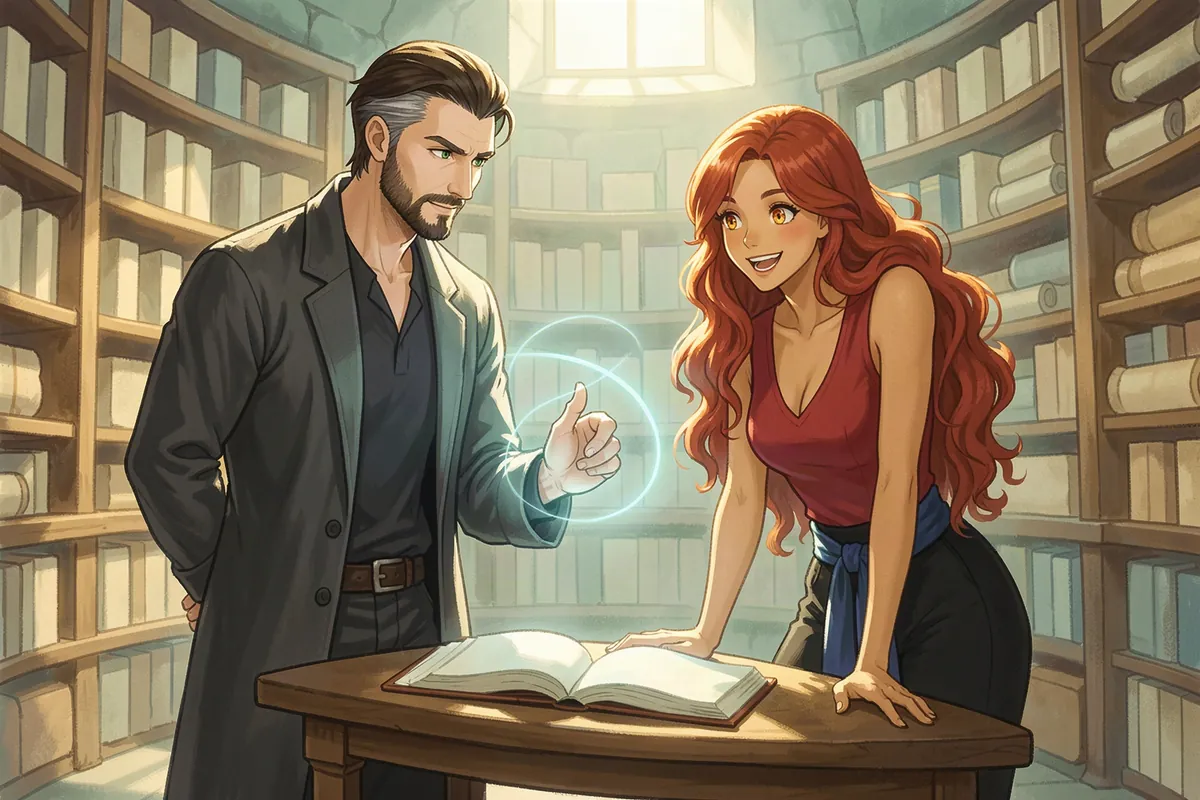
The Mentor at work: Professor Corvin Thale teaching Ines Calder in Solenne's archive.
A role is a job, not a personality, so one character can hold more than one. Snape spends most of the series as a Shapeshifter, and readers argue about whether he was a Mentor the whole time.
Anime character archetypes
Anime and manga have their own set of character types, many of them named in Japanese. Several, like the tsundere and the kuudere, have entries in Wikipedia's glossary of anime and manga. Our dere types guide covers the love-interest types in depth.
| Archetype | What they're like | Examples |
|---|---|---|
| Tsundere | Harsh or cold to the person they like, sweet underneath | Taiga Aisaka (Toradora!), Asuka Langley Soryu (Evangelion) |
| Kuudere | Calm and collected, rarely shows feelings | Rei Ayanami (Evangelion), Yuki Nagato (The Melancholy of Haruhi Suzumiya) |
| Dandere | Quiet and shy until they trust you | Hinata Hyuga (Naruto), Shoko Komi (Komi Can't Communicate) |
| Yandere | Loving at first, then possessive | Yuno Gasai (Future Diary) |
| Genki | Loud, cheerful, endless energy | Chika Fujiwara (Kaguya-sama: Love Is War) |
| Chuunibyou | Acts out a grand fantasy version of themselves | Rikka Takanashi (Love, Chunibyo & Other Delusions), Megumin (KonoSuba) |
| Shonen lead | Huge dream, never gives up, gets stronger | Naruto Uzumaki, Monkey D. Luffy |
| The rival | The hero's proud mirror, pushes them to grow | Vegeta (Dragon Ball), Katsuki Bakugo (My Hero Academia) |
| Stoic fighter | Few words, total competence | Levi Ackerman (Attack on Titan), Roronoa Zoro (One Piece) |
| Princely type | Elegant, beautiful, theatrical manners | Tamaki Suoh (Ouran High School Host Club) |
| Ojou-sama | A rich girl with refined manners and pride to match | Kaguya Shinomiya (Kaguya-sama) |
| The senpai | The older student everyone looks up to | Mai Sakurajima (Rascal Does Not Dream of Bunny Girl Senpai) |
| Kemonomimi | Animal ears and a tail on a human body | Holo (Spice and Wolf) |
| Mysterious transfer student | Arrives mid-year and clearly knows something | Homura Akemi (Puella Magi Madoka Magica) |
Villain archetypes
In Vogler's terms almost every villain is a Shadow. The type of Shadow decides what kind of story you get.
| Villain archetype | What drives them | Example |
|---|---|---|
| Dark lord | Power for its own sake | Sauron |
| Mastermind | Control through plans within plans | Professor Moriarty |
| Tragic villain | An old wound that turned into something worse | Darth Vader |
| Zealot | A cause worth any price | Judge Claude Frollo (The Hunchback of Notre Dame) |
| Anti-villain | A goal you can almost agree with, pursued by terrible means | Thanos |
| Corrupt authority | Keeps order through fear and rules | Dolores Umbridge |
| Agent of chaos | Disorder for its own sake | The Joker |
| Betrayer | Close to the hero, then turns | Hans (Frozen) |
| Monster | Hunger and instinct, no argument possible | The shark in Jaws |
Archetype vs. stereotype: how to keep an archetype fresh
A cliché is an archetype nobody questioned. Keep the core want and change something the reader expects.
| Archetype | What readers expect | A fresher take |
|---|---|---|
| Mentor | Old, wise, dies halfway through | Younger than the hero and learning the job as they go |
| Hero | Chosen by fate | Chose this and has to keep choosing it |
| Sage | Knows every answer | Knows the answer and is wrong |
| Innocent | Sheltered and sweet | Innocent on purpose, after seeing the worst |
| Ruler | A cold tyrant | Kind, and with no real power |
| Jester | Comic relief only | The jokes hide the smartest mind in the room |
| Caregiver | Selfless | Quietly keeps count of every favor |
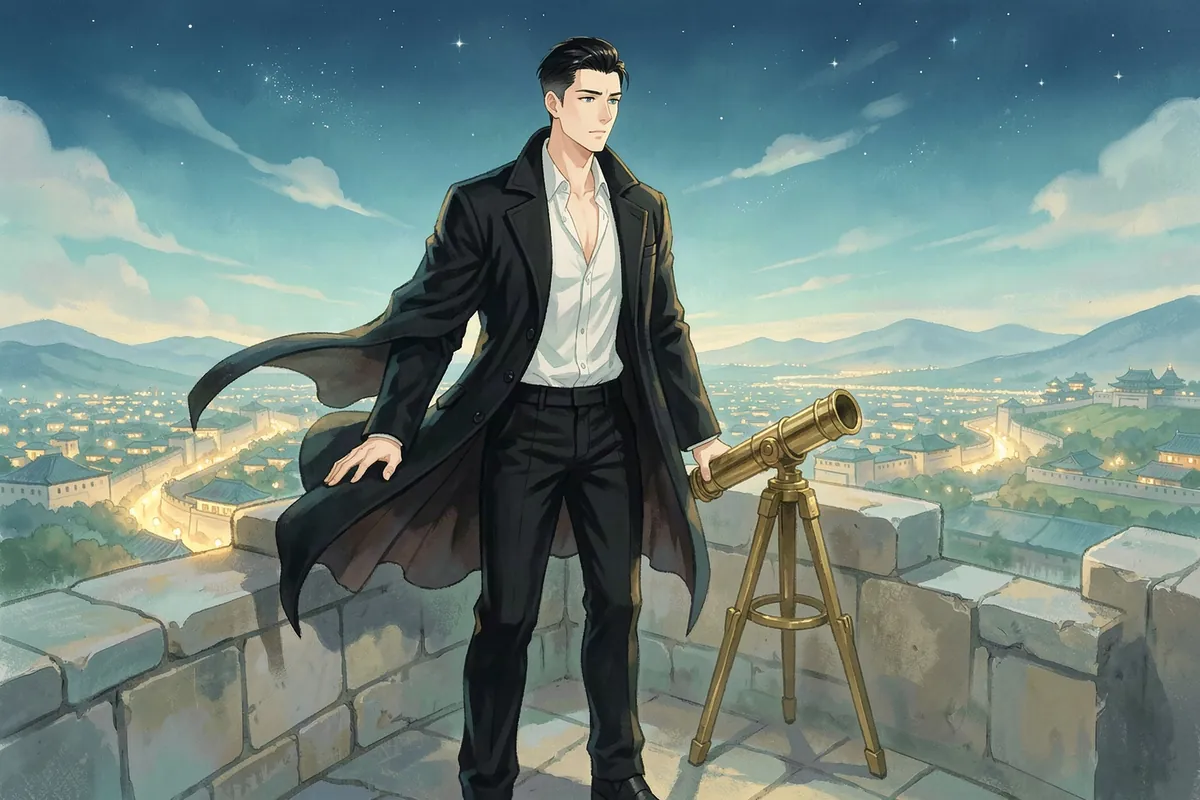
Kael Ashgrave alone on the observatory roof. A Ruler is most interesting when the thing he controls is slipping.
Three more ways to keep a type alive:
- Combine two archetypes. A Caregiver who is also a Rebel runs a medicine-smuggling ring.
- Give the flaw a cost. The trap in the table has to hurt them on the page at least once. Our character traits guide has 30 flaws with the damage each one does.
- Set them against the opposite type. Ruler against Rebel and Sage against Jester produce arguments the reader wants to hear.
How to create a character, step by step
Here is the whole process with one character built as we go: Orla, an ally for someone else's hero.
- Start with their job in the story. Are they the hero, or someone the hero needs? Orla is an ally: the healer the hero keeps coming back to.
- Pick an archetype for what drives them. Use the want and fear from the table. Caregiver: she wants to keep people alive and fears being useless.
- Add two traits that fit and one that doesn't. The odd one makes them a person. Patient, practical, and a card sharp. See 165 options in our character traits list.
- Choose a flaw that costs something. She can't say no, so she takes on everyone's problems until she breaks.
- Write the motivation as a want plus a reason. She wants to keep the village infirmary open because her brother died waiting for a healer three towns away. More in the motivation examples.
- Give them a past in three events. Her brother died. She paid a traveling surgeon to teach her with her card winnings. The infirmary now owes money to the man she beat at cards. Our backstory guide explains the method, and the backstory generator drafts one for you.
- Name them. Try the character name generator. Orla Thistlewood.
- Describe them in two details. She smells of soap and cheap tobacco, and she counts your pulse while talking about something else. See how to write a character description.
- Test them in a scene. Put them opposite someone who wants the opposite. The landlord's son arrives to close the infirmary, and he's bleeding.
If the scene in step 9 writes itself, the character works.
How to make an OC
An OC is an original character: someone you invented, as opposed to a canon character from a book, game or show. People make OCs for fan fiction, art, roleplay and their own stories. The steps above all apply, plus a few that are specific to OCs.
- Decide where your OC lives. A fandom OC lives inside an existing world, like a student at a school from your favorite series, so they have to fit its rules. An original-world OC needs a world built around them.
- Start from one hook. A single strange fact beats a long list of cool traits. Our 160 OC ideas are sorted by genre.
- Pick an archetype, then break one expectation. Use the fresher takes above.
- Design for a silhouette. Readers and artists remember a shape, two or three colors and one signature item before they remember a face.
- Give them limits. An OC who is the best at everything, loved by everyone and never wrong is what fans call a Mary Sue. One real weakness fixes most of it.
- Fill in a profile. Copy this template and keep it next to your notes.
Name:
Age and role:
Archetype:
Look (three details):
Traits (two strengths, one contradiction):
Flaw:
Wants:
Fears:
Secret:
Most important relationship:
How they talk (one line of dialogue):
- Write the backstory. Use the backstory generator for a first draft, then cut it down to the three events that matter.
- Put them in a scene. An OC only comes alive when they have to react to someone. Our writing prompts give you a first line to start from.
How to create an anime character
An anime character starts the same way as any other, then leans harder on visual design, speech and contrast.
- Pick an archetype from the anime table. Then give them one trait that cuts against it. Levi Ackerman is a feared soldier who is fussy about cleaning, and that gap is a big part of why fans love him.
- Make the hair do the work. In anime, a hair shape and color can identify a character from across the room. Pick one that nobody else in your cast has.
- Choose one signature item. Luffy's straw hat is the classic example. A scarf, a hair clip, a weapon or a pair of headphones works too.
- Set the eyes to the personality. Sharp, narrow eyes read as cool or dangerous. Large round eyes read as open and warm.
- Give them a daily life. A school year, a club, a job or a power system gives the character somewhere to be every day.
- Write how they talk. Pick a verbal habit, a catchphrase or the honorifics they use for others (-san, -kun, -chan, senpai).
- Build the cast around contrast. A tsundere next to a genki friend, a stoic fighter next to a chuunibyou. Each makes the other easier to see.
For more anime starting points, see the anime OC ideas and the dere types guide.
See the archetypes in a Mythx cast
Mythx, the AI roleplay game we make, builds each of its 13 worlds around a cast whose roles you'll recognize from this page. In Solenne, a magic academy beside the palace wall, Kael Ashgrave is the duke's heir at the top of the dueling ranks: cold, exacting and proud. Ines Calder is a loud, generous third-year fire mage. Professor Corvin Thale teaches binding theory and watches everything.
You arrive as the newcomer, design your hero's look in the hero designer, and the AI plays everyone you meet. Your hero's archetype comes from what you choose to do, so you can play a Caregiver, a Rebel or a Jester in the same academy. It's free to start in your browser with no sign-up, and your first scenes come illustrated.
Character archetypes FAQ
How many character archetypes are there? There's no fixed number. Jung wrote about a handful of major figures, the popular branding list has twelve, and Vogler's story roles have eight. Stock characters, the narrower genre types, run into the hundreds.
What are Jung's main archetypes? Jungian psychology describes the persona, the shadow, the anima and animus, and the self as systems of the personality, alongside figures like the wise old man, the child and the trickster (Wikipedia).
What's the difference between an archetype and a trope? An archetype is a type of character. A trope is any pattern that recurs in stories, such as enemies to lovers or the chosen one. Some tropes are character types, but most are plot devices.
Can a character have more than one archetype? Yes, and the best ones usually do. A character can also change archetype over a story, the way an Everyman becomes a Hero.
What archetype is the villain? In Vogler's roles, the villain is usually the Shadow. In the twelve archetypes, a villain is often a type whose trap has closed: a Ruler turned tyrant or a Rebel turned cruel.
How do I find my OC's archetype? Ask what they want most and what they're most afraid of, then match the answers to the Wants and Fears columns in the table.