How to Write a Character Backstory (Framework + D&D Examples)
By Nayan Dhabarde · Published July 11, 2026 · Updated October 4, 2026
A usable backstory fits in five sentences: origin, wound, want, mask and hook. Fill in the template below, or roll a starting point with the free backstory generator.
The five-sentence template
- Origin: "I come from ___, which taught me ___." (One fact, one consequence.)
- Wound: "The thing I don't talk about is ___."
- Want: "Right now, I am trying to ___ because I believe it will fix things."
- Mask: "Strangers would describe me as ___, which is only half true."
- Hook: "The person/place/thing from my past that could walk through the door is ___."
Sentence five is a gift to your game master or your plot: a complication you've approved in advance. Write it generously.
Why five sentences beat four pages
Picture session one. A player reads four pages of backstory aloud, and the table glazes over by paragraph two. Another player says three sentences: "I burned down my own family's forge. I don't talk about it. I'm saving to rebuild it." Now the whole table is asking questions.
Long backstories answer questions nobody has asked yet. A backstory's job is to load the character with unresolved tension that will go off during play or on the page. Anything that doesn't create tension in the present is trivia.
Test every element with one question: does this change what the character does in scene one? If a childhood in a fishing village never affects a decision, cut it, or sharpen it until it does ("she never eats fish; ask her why").
The wound, the want and the mask
The template rests on three moving parts:
- The wound is something that happened and hasn't been resolved. It needn't be tragic: a debt, a broken promise, a reward the character secretly knows they didn't earn.
- The want is what they're chasing now, usually a flawed attempt to fix the wound. The gap between the two is where irony lives: the knight seeking glory to erase his cowardice, the healer who couldn't save one specific person.
- The mask is how they present to strangers, shaped to hide the wound. Other players and readers meet the mask first, which is why it matters more than the history behind it.
The wound drives the want, the want collides with the plot, and the mask cracks under pressure. Three sentences can hold all of it, and the template adds an origin and a hook to give the story somewhere to go.
Four worked examples
Here is the template filled in word for word, twice for D&D and twice for other kinds of story.
A tiefling warlock: Mercy
- "I come from a temple that took me in to prove a point about redemption, which taught me that kindness can be a performance."
- "The thing I don't talk about is that I made my pact out of curiosity, not desperation, and the temple burned for it."
- "Right now, I am trying to pass the pact to someone who deserves it because I believe it will fix things."
- "Strangers would describe me as serene, scholarly and endlessly patient, which is only half true."
- "The person from my past that could walk through the door is my patron's other warlock, who thinks she knows how the transfer works."
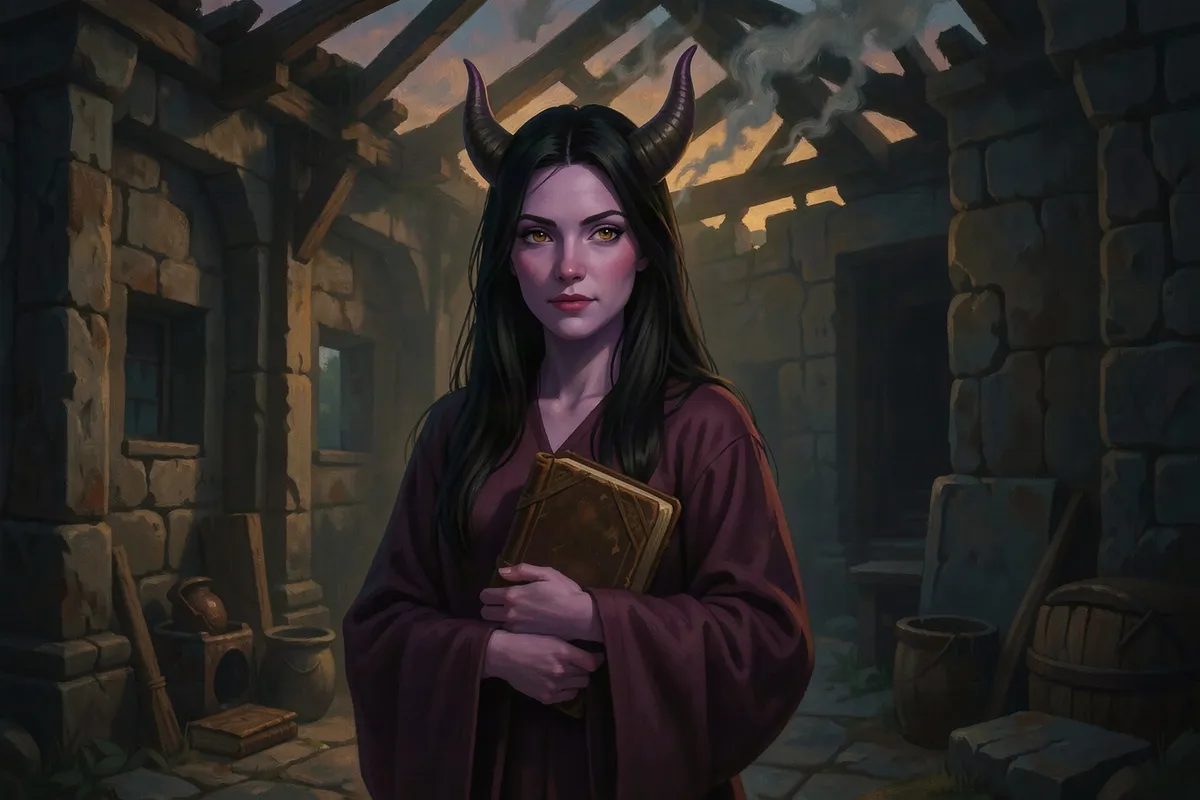
Mercy, the tiefling warlock above, at the temple that burned for her curiosity. Her hook walks in through that doorway.
Her name does work too. A virtue name like Mercy on a pact-bound character is a story by itself; the tiefling warlock name generator explains the tradition.
A half-elf druid
- "I come from a border valley where neither humans nor elves would keep me past sixteen, which taught me to be useful before anyone asks me to leave."
- "The thing I don't talk about is that I joined the circle because it asked nothing of me, and that belonging nowhere was my own choice, twice."
- "Right now, I am trying to make the grove indispensable to both communities because I believe it will fix things."
- "Strangers would describe me as the easygoing mediator who doesn't take sides, which is only half true."
- "The person from my past that could walk through the door is my human half-sister, who now runs the biggest logging company in the valley."
For his name, the half-elf druid name generator covers the circle names that suit this kind of character.
An isekai hero who wakes in another world
- "I come from a two-room apartment above a laundromat in Osaka, which taught me to fix whatever breaks without asking for help."
- "The thing I don't talk about is that my last words to my mother were an argument, and I never got to take them back."
- "Right now, I am trying to find the mage who summoned me because I believe it will fix things."
- "Strangers would describe me as cheerful and unbothered, which is only half true."
- "The person from my past that could walk through the door is Daichi, a classmate who vanished from our school a year before I did."
The hook does double duty. If Daichi has spent a year here and has no wish to go home, the hero's want is suddenly in question.
A newcomer in a cozy village
- "I come from a crowded port city, which taught me to talk to anyone and rely on no one."
- "The thing I don't talk about is the bakery I opened there, and how fast it closed."
- "Right now, I am trying to become someone this village can't do without because I believe it will fix things."
- "Strangers would describe me as relaxed and easy to please, which is only half true."
- "The person from my past that could walk through the door is my old business partner, who still owns half of my oven."
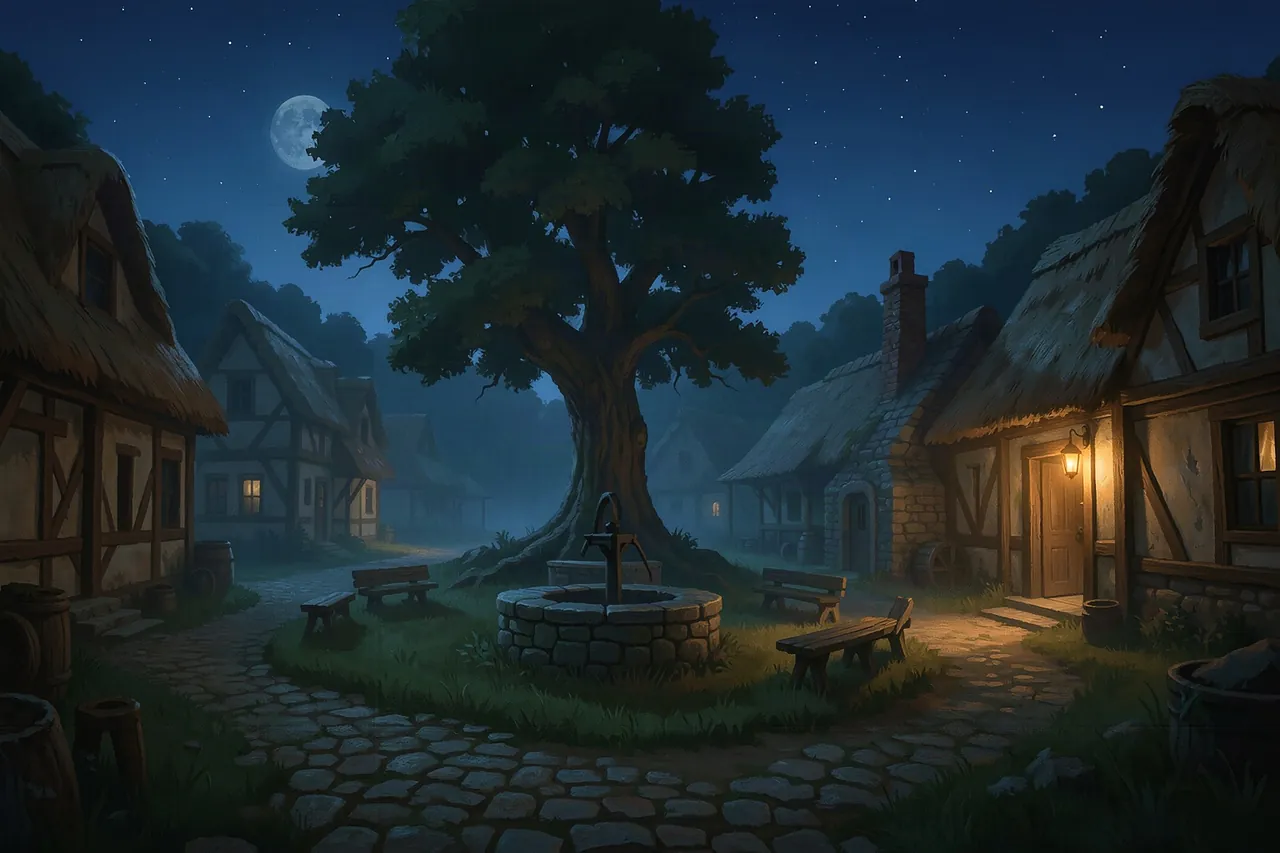
No villain needed. Low stakes still produce a wound, a want and a hook, and that's all a slice-of-life story runs on.
None of the four needs a timeline, a family tree or a list of childhood friends.
Questions to ask about your character's past
Use these when a sentence won't come. Answer in the character's voice, and keep only the answers that change what they would do today.
Where they come from
- Where did they sleep at age ten, and who else was in the room?
- How did their family make money, and was it enough?
- Who taught them the skill they're best at, and what did it cost?
- What were they punished for as a child?
- What smell or song takes them straight back home?
What hurt them
- What's the worst thing they've done, by their own standards?
- Who did they fail, and does that person know?
- What promise did they break?
- What do they lie about most often?
What they want
- What do they want that they'd be embarrassed to say out loud?
- What do they think would finally make them feel safe?
- What would they do with a year's wages and no obligations?
Who's still out there
- Who still writes to them, and do they write back?
- Who would they cross a city to avoid?
- Who owes them, and whom do they owe?
Right now
- What do they always carry, and why?
- What would make them walk away from the people they travel with?
- What question do they dread being asked?
How long should a backstory be?
It depends on who needs the information and when. A DM needs hooks before session one; a novel's reader needs the wound only when it pays off.
| Use | Length | What to include |
|---|---|---|
| D&D session zero | The five sentences, plus one secret for the DM | A hook tied to another player's character, and a lever the DM may pull |
| One-shot or convention game | Two sentences | The wound and the hook. There's no time for more. |
| Novel | As long as you like, in your notes | On the page, the mask shows in chapter one and the wound comes out late, in pieces. |
| AI roleplay | The five sentences, in your opening message or character description | Then let it come out in scenes, when other characters ask the right question. |
Backstory clichés to avoid
These aren't banned. Each one closes a door, and the fix opens it again.
| Cliché | Why it stalls | A fix |
|---|---|---|
| The orphan | The past is closed, so nobody can walk through the door | Keep one parent alive and disappointed, or leave the orphanage owed money |
| Amnesia | The player knows nothing, so the GM gets nothing to work with | Forget one specific night, and tell the GM privately what happened |
| The dead mentor | A dead mentor can't complicate anything | Keep the mentor alive and wrong, or have them leave an unfinished job in your name |
| Revenge for a murdered family | One target, one ending, and the party is along for the ride | Make the killer someone you still need, or start after the revenge, when it felt empty |
| The secret heir or chosen one | The story becomes about destiny instead of choices | Make the claim real but worthless, or give a kinder rival a better one |
| The loner who trusts no one | Other characters have nothing to push against | Add one person they trust far too much |
| The last of their kind | Nobody is left to disagree with them | Leave one other survivor who remembers it differently |
D&D specifics: flaws, bonds and session zero
If your table uses the 2014 5e character traits, the template maps onto them. The wound gives you a flaw, the want an ideal, and the hook a bond.
The 2024 rules leave those trait slots out. Instead, the character-creation chapter of the free rules on D&D Beyond suggests questions to ask yourself, including "What person or people do you care most about?" and "What's your deepest fear?" The wound usually points at the fear, and the hook often names the person.
Two rules for the table:
- Tie one sentence to another player's character. "The person who could walk through the door is your character's mentor." Shared backstory is the cheapest party glue there is.
- Give the DM one secret and one lever. The secret is something your character hides. The lever is permission: "feel free to bring my sister into the story whenever it hurts most."
Stuck? Generate a starting point
- The backstory generator gives you an origin, defining events and a motivation to adopt, twist or argue with. Arguing with a generated backstory ("no, she'd never do that, she'd...") is often the fastest way to learn who your character is.
- If the name is the missing piece, start with our fantasy character name ideas or the character name generator, and let the name suggest the wound.
From backstory to actual play
A backstory proves itself once it's in motion. Drop the character into a scene and watch whether the wound, the want and the mask produce decisions. AI roleplay is a quick way to do that: you play your character, and the AI plays everyone else.
In Mythx, the AI roleplay game we make, there's no backstory field. You design your hero's look and arrive as the newcomer in a living world, so the backstory comes out through what you say and do. After a few scenes, rewrite whichever of the five sentences didn't hold up.