50 D&D Campaign Ideas and 20 One-Shot Ideas, With Twists
By Nayan Dhabarde · Published October 11, 2026
These 50 D&D campaign ideas are sorted by type: heists, horror, intrigue, mystery, wilderness, city, sandbox, sea, war and high-level play. Each one has a hook for session one, a twist to save for the middle, and a level range. After them come 20 D&D one-shot ideas built to finish in a single 3–4 hour session, five of the easiest for new players, and a short method for turning any idea into a full campaign.
All of them are free to use and work in any edition, or in another fantasy RPG with the names changed.
Jump to: Heist · Horror · Intrigue · Mystery · Wilderness · City · Sandbox · Sea · War · High level · One-shots · For beginners · Build a campaign · DM tools · FAQ
About the level ranges. They follow the four tiers of play in the D&D rules. At levels 1–4, characters are "effectively apprentice adventurers" facing threats to farms and villages. At 5–10 the threats reach cities and kingdoms, at 11–16 whole regions, and at 17–20 the fate of the world (D&D Beyond). The rules add that the tiers have no mechanics attached, so shift a range to fit your table.
Heist campaign ideas
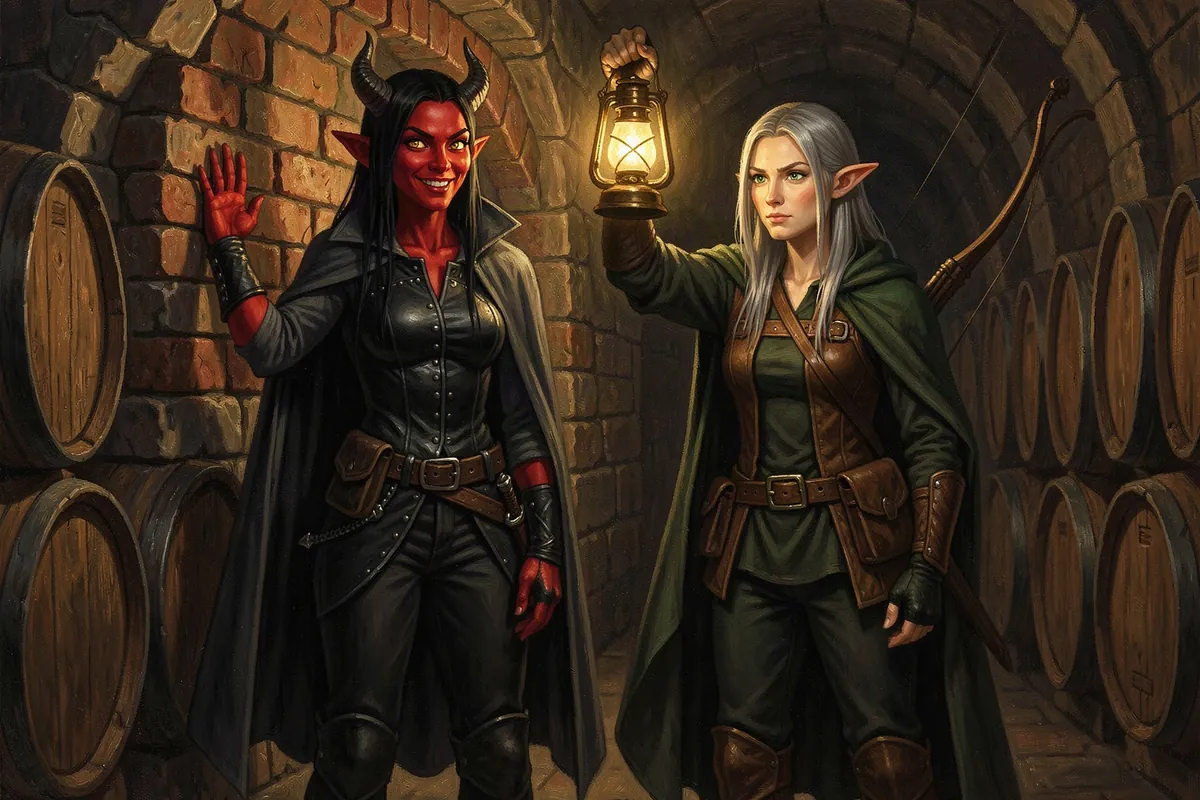
Idea 1 borrows its cellar from The Hollow Lantern, an adventurers' tavern in Mythx. The twist is ours, not the game's.
The Bricked-Up Arch (levels 1–4). The party inherits a run-down tavern, its regulars and a debt that falls due in thirty days. The noble house holding the debt would rather have the building than the money. At the far end of the cellar, behind the casks, is an arch someone bricked up long ago. Twist: the old owner bricked it up to keep something in, and the noble house wants the building because it knows what.
The Auction of Small Things (levels 3–6). A dead archmage's estate goes to auction, and a client pays the party to steal one lot before the bidding starts: a plain blue teacup. Twist: four other crews were hired for the same cup by the same client, who doesn't need it stolen. He needs everyone watching the cup while his real crew empties the archmage's study.
Rob the Bank of the Gods (levels 5–10). A temple keeps the city's tithes in a vault guarded by a minor god, who by its own law must answer one question truthfully for each visitor. Twist: the god wants to be robbed. It has been trapped in that vault for three hundred years and is hoping the right question sets it free.
The Long Con at Court (levels 5–10). The party poses as a foreign delegation for one season to trick a duke into signing away a border fortress. Twist: the duke saw through them on day one and plays along. He needs the treaty signed by someone he can disown later.
Steal Back the Sun (levels 11–16). A dragon has hoarded a city's daylight inside a gem, and the city has lived in a gray dusk for a generation. Twist: the city's founders gave the daylight to the dragon on purpose. Something that hunts by sunlight was looking for them, and it is still looking.
The Debtors' Prison (levels 1–4). A friend has been jailed for a debt they swear they never owed and will be shipped to the salt mines in nine days. Break them out. Twist: the friend owed it. They took the blame for the person who hired the party.
Horror campaign ideas
The Bell That Counts (levels 1–4). A village bell rings by itself once for every person in the valley who will die tomorrow. Tonight it rings four times, and nobody in the village is sick. Twist: the count matches the party. The bell isn't predicting their deaths but warning them about the inn they plan to sleep in.
The Quiet Flock (levels 3–6). In a hill village, the sheep stopped making any sound. A week later the dogs went quiet, then the babies. Twist: something in the hills is collecting voices so it can talk to people. It took the party's voices from their first conversation in the village and uses them to call the villagers out at night.
Second Sunday (levels 5–10). A market town keeps waking up on the same Sunday, and only the party remembers the loop. Each time, one more townsperson is gone. Twist: the loop is a defense. A thing outside time takes one person for each real day that passes, and the town's priest started the loop to slow it down.
The Dollmaker's Gift (levels 3–6). Dolls from the local toymaker appear in houses that never bought one, always facing the bed. Parents want the toymaker hanged. Twist: the dolls are guards. The houses without one are the houses being emptied, and the toymaker is working as fast as she can.
The Hollow Saints (levels 5–10). Along a pilgrim road, someone has replaced the saints' bones in every shrine with fakes, and pilgrims who pray at the fakes come home strange. Twist: the church took the real bones itself, because the saints were holding something down and it has started to wake.
The House That Adds Rooms (levels 1–4). A manor gains one new room every night. The heir hires the party to map the house before the will is read in a week. Twist: each new room is one of the dead owner's memories. The last one holds the memory of who poisoned him.
Intrigue and political campaign ideas
Five Heirs, One Crown (levels 5–10). The old queen died without naming an heir, and five claimants have one winter to win the council's vote. Each of them hires the party in turn. Twist: the queen isn't dead. She is watching which heir the party chooses, because she trusts their judgment more than the council's.
The Ambassador's Shadow (levels 3–6). The party guards a foreign envoy through a week of peace talks while three groups try to kill him. Twist: the envoy is a body double. The real one is across the city, meeting the enemy general the talks are meant to stop.
The Errand Gangs (levels 1–4). Two gangs of children who run the city's messages are fighting over delivery routes, and adults have started turning up dead. Twist: the guild masters are using the children to carry orders for a coup, and the dead adults are couriers who read the notes.
A Courtship of Convenience (levels 3–6). One character must pretend to court a noble for a season to save their family's land. Twist: the noble is pretending too, to save land on the other side of the same dispute, and both families hired the same matchmaker to spy.
The Fey Name-Debt (levels 11–16). A fey court claims one noble family name each generation, and this year it's the party's patron. Twist: the patron's family took that name from a peasant family two hundred years ago. The fey only want it returned to its owners, who still farm below the castle.
The Stone Election (levels 5–10). A merchant republic chooses its leader once every twenty years by drawing stones from an urn. Rigging the draw is a tradition, but this time every faction has rigged it. Twist: an oracle counts the stones, and she can't lie. This year she has decided to stay silent, which nobody planned for.
Mystery campaign ideas
The Mapmaker's Last Map (levels 1–4). A mapmaker is murdered the night before finishing her survey of the marsh. Twist: the unfinished map shows a village the town council swears was abandoned a century ago. People still live there, and they pay the council to stay off maps.
The Missing Season (levels 5–10). Everyone in the kingdom has lost the same three months of memory. Twist: in those three months the kingdom won a war. Someone erased the memory so no one would remember how it was won.
Thirteen at the Inn (levels 3–6). Snow traps thirteen guests at a mountain inn, and one dies every night. The party isn't suspected yet. Twist: the victims sat on the same jury ten years ago, and the innkeeper was the one they convicted.
The Wrong Body (levels 3–6). At the duke's funeral, the body in the casket is a stranger wearing the duke's ring. Twist: the duke traded places with the stranger to escape a contract with a devil. The stranger agreed, for a price the party will want to know.
Ink of the Dead (levels 5–10). A scribe's ink lets the dead write, and a murdered witness writes the name of a respected priest. Twist: the dead are lying. A necromancer coached them, and the priest is the one who has been hunting him.
Wilderness and exploration campaign ideas
The Road That Moves (levels 1–4). A trade road takes a different route every night, and caravans arrive weeks late or at the wrong city. Twist: the road is the spine of a sleeping wyrm that stretches in its sleep. It is starting to wake up.
Beyond the Last Map (levels 5–10). The party escorts a cartographer to chart the edge of the known world. Twist: at the edge they meet another expedition charting inward from the other side. To them, the party's homeland is the unknown country.
The Turning of the Herds (levels 3–6). The great herds on the plains have turned and are running toward the farmlands. The lords want them stopped. Twist: the herds are fleeing something under the plains, and stopping them puts the farms between it and the herds.
The Winter That Won't End (levels 5–10). Spring is three months late, and the party learns a druid circle has stopped the seasons. Twist: the druids froze the year to keep a glacier from melting. A buried city is thawing inside it, along with the plague that killed it.
The Island of Clocks (levels 3–6). The party is shipwrecked on an island where time runs ten times faster than at home, so every hour there costs a day back home. Twist: the island's ruler is one character's grandmother. She was shipwrecked there last month by her family's count.
The Seed Vault (levels 11–16). A great forest is dying from the center outward, and at its heart is a vault holding seeds of every plant that ever went extinct. Twist: the forest is killing itself to keep the party's employer out of the vault.
City campaign ideas
Dawn over the rooftops of Carrowgate, the walled city around The Hollow Lantern.
The Sewer Court (levels 1–4). The city's sewers have their own working government of wererats, smugglers and a lich who keeps the books. The council hires the party to collect back taxes from it. Twist: the Sewer Court has secretly paid the city's bills for years, and the council above is broke.
The Night Market (levels 3–6). Each full moon, a market opens in a different alley and sells memories, years of life and lost things. Twist: the market's owner is buying the city one alley at a time, and each alley he owns forgets it was ever part of the city.
Firewatch (levels 1–4). The party joins the city's volunteer fire brigade in a summer of arson. Twist: the fires are clearing a straight line across the city, the path of something big moving under the streets.
The Lamplighters' Strike (levels 3–6). The lamplighters walk off the job, the city goes dark, and things that hate light come up from below. Twist: the guild struck to force the council to admit what the lamps were really for.
Tower Rent (levels 5–10). A wizard has stopped paying rent on his tower in the middle of the city, and the landlord hires the party to evict him. Twist: the tower's wards hold up half the district's foundations. Evict him and the district falls into the caves below.
Sandbox campaign ideas
A sandbox campaign has no set plot. The players pick where to go, and the world reacts. The best-known version is Ben Robbins' West Marches campaign, where "there was no regular plot: the players decided where to go and what to do," and the players scheduled their own sessions (Ars Ludi).
The Frontier Town (levels 1–10). The party lives in the last town before an unmapped region of ruins, forests and old roads. Every session is an expedition the players choose, and they come back to town to rest and trade rumors. Twist: keep a list of what the players skipped. Ignored threats grow, and one of them eventually reaches the town.
The House at the End of the Road (levels 1–4). The party inherits "the house at the end of the road" in a valley with six roads. Twist: all six houses turn out to be theirs, and so do the six family feuds that come with them.
Ten Towers (levels 5–10). Ten sealed wizards' towers across a region open on the same night after a hundred years. Each holds a piece of one artifact, and a rival party is racing for them. Twist: the rivals are the wizards who built the towers, reborn and not quite remembering why.
The Valley of Clocks (levels 3–6). A valley holds a dying king, a regent, a bandit army and a young dragon, and each has a goal and a deadline. The players choose what to deal with first. Twist: whichever faction the party ignores the longest wins.
Sea and nautical campaign ideas
The Ghost Fleet's Back Pay (levels 5–10). A fleet of ghost ships is attacking merchant convoys. The dead sailors have one demand: the wages they were never paid. Twist: the admiralty that owes them is the party's employer, and it would rather sink the ghosts than pay them.
Letters of Marque (levels 3–6). The party gets privateer papers in a war that ends three sessions in, and overnight they're pirates. Twist: the peace treaty includes a secret clause written to make them outlaws.
The Titans' Divorce (levels 11–16). Two sea titans have separated and split the ocean between them. Every port has to pick a side. Twist: they'll only reunite if the same mortal betrays both, and both have picked the party for the job.
The Dark Lighthouses (levels 1–4). Lighthouses are going dark one by one up the coast, and ships are wrecking. Twist: the keepers aren't dead. They walked out to sea to guide something in, and they left their lamps for whoever comes next.
War campaign ideas
The Marrow House gate after dark, in The Hollow Lantern's art style.
The Wrong Side (levels 5–10). Drafted into a lord's army, the party learns their side started the war on a lie. Twist: switching sides makes them traitors to both armies, and both send the same bounty hunter.
Ninety Days (levels 3–6). The city is under siege, and a relief army is ninety days away. The party has to keep the walls, the food and the peace inside the gates until then. Twist: the relief army's general is in no hurry. He wants the city weak enough to rule when he arrives.
The Last Egg (levels 11–16). Both sides of a long war have lost their dragons, and one dragon egg remains. Twist: the hatchling will bond with whoever is present at the hatching, and the egg starts to crack while the party's least trusted member is on watch.
After the War (levels 1–4). The war ended a year ago. The party are soldiers coming home to a town that has moved on without them. Twist: their old unit's last order was never canceled, and someone in town is still carrying it out.
High-level and planar campaign ideas
The Gods Are on Strike (levels 11–16). On the same morning, every prayer stops working. Twist: the gods are hiding. Something has come to their plane that feeds on whatever is worshipped.
The Library at the End (levels 11–16). A library holds every book from every world, and someone is burning the last chapters. Twist: the arsonist is trying to stop one world's ending from happening, and it's the party's world.
Hell's Forged Contracts (levels 11–16). A devil hires the party to find out who is forging soul contracts. Twist: the forger is an angel who has been saving souls by slipping fake clauses into real contracts.
The Last Night of the World (levels 17–20). The sun won't rise again, and the party has one night to decide who gets saved. Twist: the gods set this up as a test, and the answer they hope for is that the party refuses to choose.
20 D&D one-shot ideas
A one-shot is an adventure that starts and ends in one session, usually 3–4 hours. Each idea below has one clear goal, so the table knows what winning looks like within minutes.
A structure that fits in one session. Johnn Four's Five Room Dungeon gives a one-shot its shape in five beats: entrance and guardian, a puzzle or roleplaying challenge, a trick or setback, the climax, and a reward, revelation or plot twist (Roleplaying Tips). The rooms don't have to be rooms. They can be streets, a ship's decks or five conversations. For a 3½-hour session, a rough budget:
| Beat | Time |
|---|---|
| Hook, then the entrance and its guardian | 30 minutes |
| A puzzle or a talk that brute force can't solve | 40 minutes |
| A trick or setback that changes the plan | 40 minutes |
| The climax | 60 minutes |
| The reward, reveal or twist | 15 minutes |
That leaves about 25 minutes for introductions and snacks.
- The Wedding Heist (levels 1–3). Steal the bride's family jewels during the vows. Complication: the bride hired the party too, to make sure they get stolen.
- The Last Ferry (levels 1–3). Get five passengers across a haunted river before midnight. Complication: one passenger is a ghost and doesn't know it.
- The Cheese Festival (levels 1–2). Find the stolen prize cheese before the judging at noon. Complication: the thief is a cursed mouse who was last year's judge.
- Escape the Goblin Market (levels 1–3). The party wakes up in cages, already sold at a goblin market. Get out before the buyers arrive at dawn.
- Count the Hoard (levels 2–4). A dragon hires the party to count its hoard by sunset, then accuses them when three coins are missing. Find the coins or the thief.
- One Night at the Inn (levels 1–3). The inn's ghost will let the guests leave in the morning if someone answers its three questions. Nobody has managed it in forty years.
- The Toll Bridge (levels 1–2). A troll lets travelers cross for one true secret each. The party has to get a merchant's wagon across, and the merchant has a lot of secrets.
- The Bog Bounty (levels 2–4). Bring a bandit back from the marsh alive. Complication: the bandit is a hero to the village that posted the bounty.
- The Masquerade (levels 3–5). Unmask an assassin at a masked ball before the clock strikes twelve. Nobody at the ball is wearing their own face.
- The Mine Rescue (levels 1–3). Miners are trapped below with three hours of air. Run it on a real clock on the table.
- The Storm in a Jar (levels 2–4). A weather wizard's jar has broken, and a small storm is loose in the village. Catch it before it grows big enough to flood the valley.
- Jailbreak From the Inside (levels 1–3). The party starts in the cells with nothing. Escape, find the gear and get out the gate.
- The Dungeon Delivery (levels 2–4). Deliver a package to the bottom of a dungeon. The monsters on the way are the customers, and some of them are expecting a refund.
- The Tavern Brawl Tournament (levels 1–3). Win a bare-knuckle tournament without killing anyone, while a rival crew tries to fix the bracket.
- The Prince Who Won't Be Rescued (levels 3–5). Rescue a kidnapped prince who would much rather stay with the kidnappers.
- The Apprentice Exam (levels 1–3). A wizard's apprentice has one final exam: get past the party. The party doesn't know they're the exam.
- The Long Shadows (levels 3–5). At sunset, everyone's shadow in town walks away. Get them back before sunrise, or the shadows keep the town.
- The Coach Race (levels 2–4). Win a cross-country coach race for a crooked sponsor while three other teams play dirty.
- The Bakery Siege (levels 1–3). Hold a bakery against a mob of goblins who want one specific pie, and find out why that pie.
- The Will Reading (levels 3–5). A rich stranger's will names the party as heirs. The family wants them dead before the lawyer finishes reading.
D&D one-shots for beginners
For a table of new players, pick an idea with one simple goal, a clear villain or obstacle, and one fight in the first hour, so the rules come up early. Five from the list that fit:
- The Cheese Festival (3): silly stakes, a clear deadline, and a culprit players can talk to
- Escape the Goblin Market (4): one goal, obvious from the first minute
- The Toll Bridge (7): teaches roleplay without much combat
- The Mine Rescue (10): a visible clock keeps everyone moving
- The Bakery Siege (19): one location, one fight, and a mystery about a pie
A few habits make a first session easier. Hand out ready-made level 1–3 characters so nobody spends an hour on a character sheet. State the goal in the first five minutes. Give each character one reason to care about it. Plan for three hours, because new players take longer on every decision. The official free rules on D&D Beyond cover everything a beginner table needs.
How to create a D&D campaign from an idea
Pick one idea above and build only what the first session needs.
- Write session one, not the whole campaign. You need the hook, three places the players can go, and one surprise.
- Give the villain a goal and a deadline. Write down what happens each week if the party does nothing. Then the world moves on its own.
- Add three factions that want different things. For each, write what they want, what they'll do to get it and what they won't do. The world building guide shows the method on a small village.
- Tie one secret to each player character. Ask players for a backstory with a loose end, or use the free backstory generator to write one.
- Plan each session from the last one. What did the players care about? Build more of that and less of what they skipped.
If you want more premises, our 100 story ideas with a twist adapt well to campaigns.
Free DM tools and D&D generators
These free generators on Mythx work in the browser with no sign-up:
- Plot generator: a premise built from a protagonist, a conflict, an obstacle and a setting
- Fantasy world generator: fantasy locations, realms and lore for a quick setting
- NPC name generator: everyday names you can say at the table without stumbling
- D&D character name generator: names for any species and class
- Villain name generator: a name, often with a title, for your big bad
- Tiefling name generator: infernal names and virtue names
- Backstory generator: a full backstory with a secret and three story hooks
- Roleplay generator: a quick scenario when the players wander off the map
The tools page lists all of them, and our 200 fantasy character names are sorted by culture.
Play a campaign idea solo
If your group can't meet, you can play an idea alone. Mythx, the AI roleplay game we make, has an AI dungeon master that narrates the world, plays everyone you meet and remembers what you did. You type what your character does, in your own words. There are no dice, stats or 5e rules, so it plays like a story game rather than a rules-heavy D&D session.
The closest world to a D&D campaign is The Hollow Lantern: you inherit a run-down tavern in a walled city, along with its debt and its regulars, who include an elf ranger, a tiefling rogue and a drow wizard. It's free to start in your browser with no sign-up, and your first scenes come illustrated. For rules-first options with dice, our Friends & Fables alternatives and AI Dungeon alternatives lists compare the other apps.
Dungeons & Dragons and D&D are trademarks of Wizards of the Coast. This post isn't affiliated with or endorsed by Wizards of the Coast.
D&D campaign ideas FAQ
What makes a good D&D campaign idea? A clear hook the players can act on in session one, a villain or problem that gets worse if they do nothing, and a twist that changes what the campaign is about. Each idea above has all three.
How long is a D&D one-shot? Usually one session of 3–4 hours. Plan for about 3½ hours of play, with a single goal and a five-beat structure like the one above.
What level should a one-shot be? Levels 1–3 work best for new players because characters have few abilities to learn. Experienced groups often play one-shots at higher levels to try characters they'd never reach in a long campaign.
What is the difference between a campaign and a one-shot? A one-shot starts and ends in one session. A campaign runs over many sessions with the same characters, and its story can change based on what the players did before.
How do I start my first D&D campaign as a DM? Run a one-shot first. Then pick a campaign idea, write only session one, and use the steps above to plan from there.
Can I play a D&D campaign alone? Yes, with an AI game acting as the dungeon master. Mythx's AI dungeon master plays everyone you meet, without dice or 5e rules, and the solo section above covers how it works.