How to Build a Fantasy World: A Practical Worldbuilding Guide
By Nayan Dhabarde · Published July 11, 2026 · Updated October 4, 2026
Build outward from the first scene, and only build what the story can touch. The checklist below is the whole method, and it works for a D&D campaign, a novel or an AI roleplay world.
The method in one evening
- One location in detail: the pub, with four questions answered
- Geography only where it creates friction: distance, borders, terrain
- One big lie, with three everyday consequences
- Five scars of history
- Three factions: what each wants, will do, and won't do
- One belief and one trade: what's worshipped, what's made, and who profits
- Two or three sound families for names
- One price for magic
- One scene played inside it, to test the seams
Each step gets a section below, and a small village gets built along the way as a worked example.
Start with a pub, not a planet
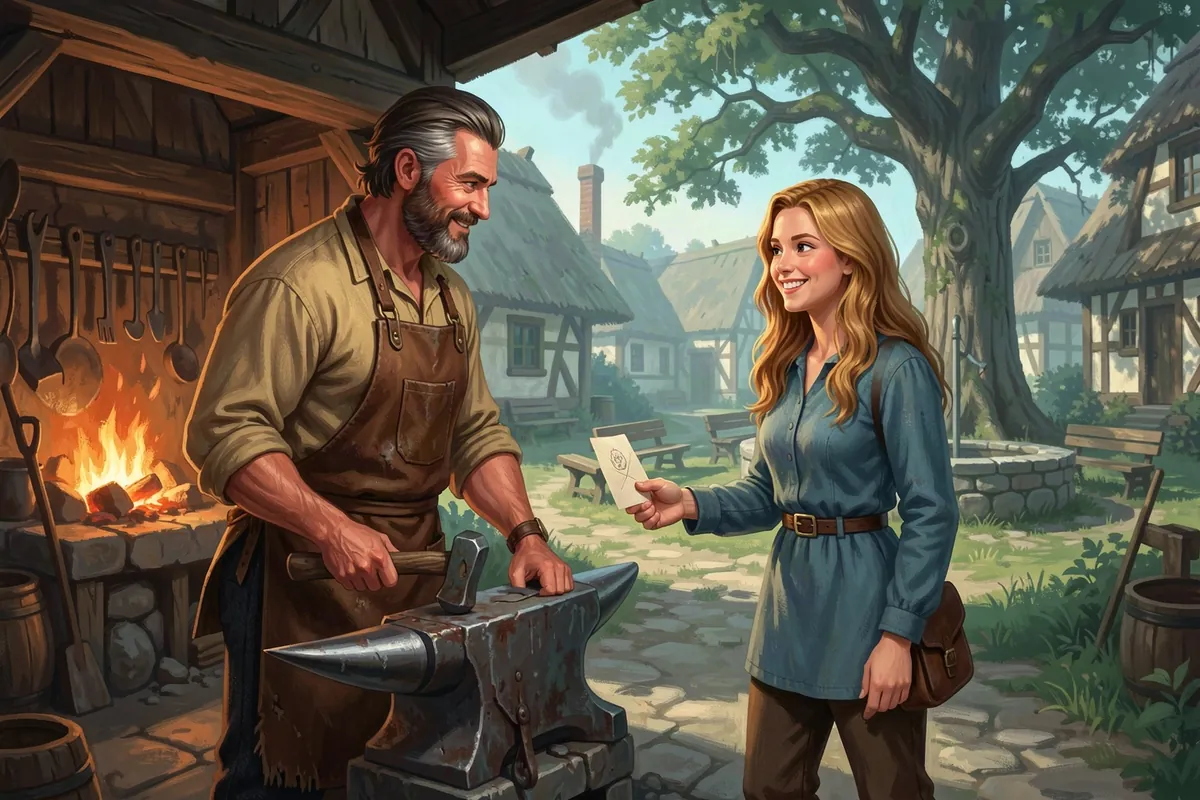
Wren, Emberhollow's letter-carrier, brings Bram the blacksmith his post. The Mythx village is built this way: ten places and a cast of eight who all live within a walk of each other. See its people.
Most worldbuilding advice tells you to start with a planet: continents, tectonic plates, three thousand years of history. Six weeks later you have an encyclopedia and no story. Working game masters and novelists go the other way.
Your story starts somewhere specific: a tavern, a border checkpoint, a failing lighthouse. Build that first, in real detail:
- Who runs this place, and what do they want that they can't have?
- What do locals argue about when strangers aren't listening?
- What's the one rule everyone here follows that an outsider wouldn't know?
- What arrived recently that changed things?
Answer those four and you have more usable world than most hundred-page setting bibles, because every answer is something a character can bump into in scene one. The kingdom's tax policy can wait until someone gets taxed.
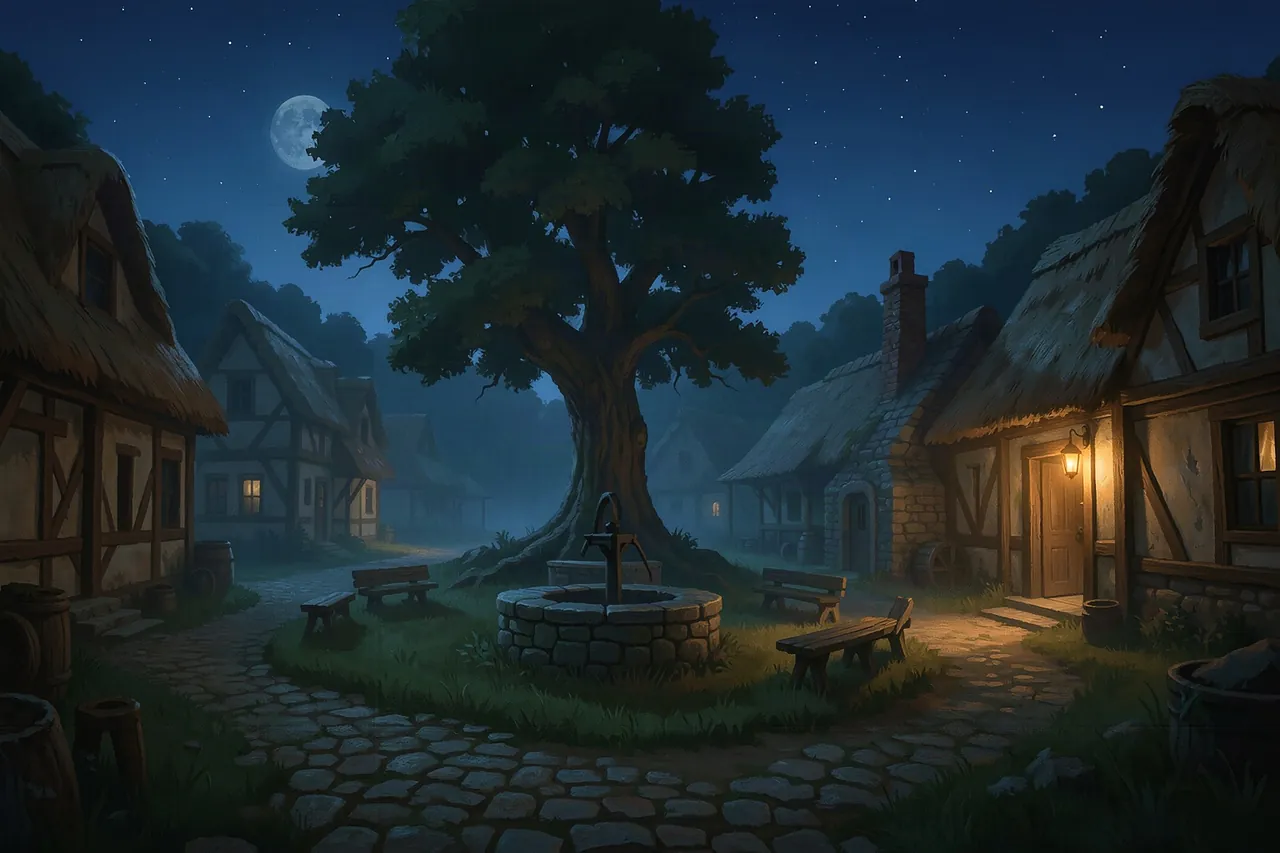
Worked example. Our village takes its shape from Emberhollow, the cozy fantasy village in Mythx, the AI roleplay game we make. It has thatched roofs, forge smoke, a mill pond, ten places and a cast of eight who all know each other. The names and jobs below come from the game. The rest is our own illustration of the method, not the game's lore.
The pub is the Sleeping Hart, kept by Ysolde Marr: bread, ale and most of the village's conversation.
- Who runs it, and what does she want? Ysolde wants rooms for travelers, and the only free land next door belongs to the mill.
- What do locals argue about? Rose beds, and who gets to judge them at the harvest fair.
- The rule outsiders don't know: nobody sits in the chair by the hearth. It belongs to Alder Brackwell, the retired road-warden, on the evenings he comes in.
- What arrived recently? New tenants for the empty cottage at the end of Kiln Lane. By lunchtime, half the village knows their names.
Let geography follow story
A map drawn before the story is a cage. Place geography where the story needs friction instead:
- Distance creates cost. If help is three days away, every crisis is a real crisis.
- Borders create identity. People define themselves against whoever lives across the river.
- Terrain creates work. A river town has ferrymen and toll disputes; a hill village has shepherds and a long walk to market.
When you need a location instantly (a village the players suddenly ride toward, a ruin your protagonist spots from the road), a generator saves the session. The free fantasy world generator produces named locations with flavor you can adopt or remix on the spot.
Worked example. The village sits in a valley, and Wren Fenn carries messages and parcels along the valley road. In our version, the nearest physician is a day away by cart, so Tamsin Vole, the herbalist by the pond, handles everything short of surgery. The border is the mill pond's footbridge: by village logic, anyone living on the far side is slightly suspect.
Give your world exactly one big lie
Strong fantasy worlds usually rest on a single departure from reality, the big lie, and play everything else straight. The dead remember. Iron is toxic to gods. The tide went out a century ago and never came back.
The rule is old. In his 1933 introduction to The Scientific Romances of H.G. Wells, H. G. Wells argued for one impossible hypothesis per story. The rest of the story needed "a rigid exclusion of other marvels," because "nothing remains interesting, where anything may happen" (quoted in the SF Encyclopedia).
Pick the lie that generates the most interesting everyday consequences, because everyday life is where characters spend their time. If the dead remember, what happens to inheritance law? To murder investigations? To weddings?
Worked example. Our lie: small hedge magic works, and nothing bigger does. A charm really will keep milk from turning or a cough from settling. Three consequences follow. Tamsin matters to the village as much as the miller does. Bread sold as "charm-kept" fetches more at market, and people argue about whether that's honest. Children learn three charms before they learn to read.
History should leave scars, not chronicles
Readers and players don't experience history as a timeline. They experience it as scars in the present:
- A generation of missing men after the last war
- A holiday nobody celebrates sincerely anymore
- A word it's rude to say in front of southerners
- A tower that everyone pretends not to see
Write five scars instead of five centuries. Each one implies the history behind it, and implication is cheaper and more evocative than exposition. When someone asks about a scar, then write the history that explains it, for an audience that now cares.
Worked example. Five scars for the village:
- A retired road-warden in a valley whose road hasn't needed guarding in years
- A forge worked by the Tallow family for three generations, and a different family's mark on the oldest anvil
- The cottage at the end of Kiln Lane, which stood empty for years before you arrived
- One new plank in the middle of the old footbridge
- A rose cup at the harvest fair that one family has stopped entering
Factions beat nations
Stories run on groups of people who want incompatible things. Think of the miners' guild against the river barons, the old temple against the new one, or the crown against everyone who remembers the previous crown.
For each faction, you need only three lines:
- What they want. Make it concrete, not "power": a specific mine, a throne, someone's forgiveness.
- What they'll do to get it. The line they will cross.
- What they won't do. The line they won't cross. This is what makes them feel human.
Three factions with clear wants generate more plot than any amount of geography. If you need plot skeletons to hang on them, the free plot generator is built for that.
Worked example. Village factions are village-sized:
Faction Wants Will Won't The mill (Rhys Weir) The pond kept high for a full grinding season Close the sluice without asking anyone Let a neighbor's field flood Tamsin's herb garden The reed bed that the high water drowns Charge the mill house full price for charms Lie about what a charm can do The rose growers The rose cup at the harvest fair Gossip, and compost at strategic hours Touch another grower's bushes
Religion: what's worshipped, and who profits
You don't need a pantheon. You need to know what ordinary people do about the sacred on an ordinary day:
- What's worshipped. A god, the ancestors, the river, the harvest. Pick one thing most people pray to and one thing they're afraid to offend.
- Who runs it. A priesthood, every grandmother, or nobody in particular.
- Who profits. Someone sells the candles, owns the shrine land or collects the tithe. That person is a character.
- One taboo. Something nobody does, and the story people tell about the last person who did.
Worked example. The village green has a well and an old oak. In our version, the oak is the nearest thing to a shrine, and couples tie ribbons to it before a wedding. Bram Tallow, the blacksmith, quietly sells the iron nails the ribbons hang from. The taboo: nobody draws water from the well on fair day.
Economy: what's made, what's owed, and who profits
Follow the money through one ordinary week:
- What the place makes that others want, and what it has to buy in.
- Who holds the debts. A world with credit has creditors, and creditors have leverage.
- What money looks like. Coin, barter, favors, grain receipts.
- Who profits from things as they are, and who would profit from a change. Plots start with the second group.
Worked example. In our version, the valley sells wool cloth (Maren, your mother in the game, is a weaver) and buys in salt and iron. The miller keeps a share of every sack he grinds, the old miller's toll, so every good harvest pays him twice. Bram Tallow is generous with credit, which means half the village owes the forge something, and nobody says so out loud.
Name things like they were named by people
Naming is where worldbuilding most often breaks immersion. Real places are named by tired locals ("Northbridge", "the Hollows"), by conquerors, or by whatever the old name wore down into. A quick consistency method:
- Pick two or three sound families for your cultures and stay inside them
- Let common places have boring names and old places have opaque ones
- Let names drift: Caer Maddoc becomes Karmadock after three centuries of merchants
Character names follow the same logic. Our list of 200 fantasy character names is sorted by sound family. The free name generators cover common cases, from the D&D character name generator to the tiefling warlock and half-elf druid ones. Each comes with naming notes you can borrow for your own cultures.
Worked example. The village's names are the plain kind real villages have: Kiln Lane, the Mill Pond, the Village Green, Tallow's Forge. Only the inn, the Sleeping Hart, sounds like it has a story behind it.
Magic needs a price tag
You don't need a full magic system; you need a price. Magic that costs nothing solves every plot in one page. Pick a cost that creates drama: years of life, memory, sleep, a debt to something that keeps ledgers. Make it a cost the caster can talk themselves into paying, because that choice is where character comes from.
Then charge it every time. A price that applies only when it's convenient makes the world feel arbitrary.
Worked example. In our version, each charm costs the caster a night's sleep. Tamsin could keep every jug of milk in the valley sweet, but not for long, and the whole village can tell when she has overdone it.
The explorable-world test
The quality bar: could someone else make a decision in your world without asking you? If a friend dropped a character into your setting, would they know roughly what's dangerous, what's sacred, what's for sale and who's in charge? That's what "lived-in" means. The rules are legible enough to act on.
The fastest way to run the test is to play inside it. Describe your world's big lie, a faction and a starting scene to a general-purpose AI model. Then see whether the story that comes back feels like your world or a generic one. The moment the world can't answer a question, you've found the next thing to build.