What Is Isekai? Meaning, Types, Tropes and Examples
By Nayan Dhabarde · Published October 11, 2026
Isekai (異世界) is Japanese for "another world" or "different world." It names a genre of Japanese fantasy and science fiction in which a person from our world is transported to another one and has to survive there, usually gaining powers or an importance they never had at home (Wikipedia).
The word is common enough now that the Oxford English Dictionary added "isekai" in March 2024. Most isekai anime today start as free web novels that became light novels and manga first. Below are the main kinds, the tropes fans joke about, and where the genre came from.
Jump to: Meaning · Types · Tropes · History · Why it's popular · Write or play one · FAQ
What does isekai mean?
I (異) means different and sekai (世界) means world. In anime and light-novel circles, isekai refers to the story type more than the word itself: an ordinary person leaves our world, by death, by summoning or through some object, and wakes up somewhere new. A common destination is a medieval fantasy world of humans, other humanoid races and monsters (Wikipedia).
Types of isekai
How the hero gets to the other world is the usual way to sort the genre. Writer Paul Price lists six routes: reincarnation, an act of a god, summoning, a specific object, being pulled into a game, and no explanation at all (Wikipedia). In practice, fans talk about these six kinds:
| Type | What happens |
|---|---|
| Transported | The hero crosses over alive, as they are |
| Reincarnated | The hero dies and is reborn in the new world with their memories |
| Summoned | Someone in the other world calls the hero there |
| Trapped in a game | The hero is stuck inside a game world that has become real |
| Reverse isekai | Someone from a fantasy world lands in ours |
| Villainess (otome) | The heroine is reborn as the villain of a dating game and tries to avoid her bad ending |
Transported. In the first Twelve Kingdoms novel (1992), high school student Yoko Nakajima is pulled into a fantasy world and has to survive there as a hunted outsider (Wikipedia).
Reincarnated. In That Time I Got Reincarnated as a Slime, 37-year-old office worker Satoru Mikami is stabbed while protecting a colleague and wakes up as a slime named Rimuru (Wikipedia). Mushoku Tensei reincarnates an unemployed 34-year-old as Rudeus Greyrat, who resolves to live his second life without regrets (Wikipedia). In KonoSuba, the goddess Aqua reincarnates Kazuma Satou, and instead of a powerful item he picks Aqua herself to come along (Wikipedia).
Summoned. Naofumi Iwatani is summoned with three other young men to serve as one of four legendary heroes in The Rising of the Shield Hero (Wikipedia). Subaru Natsuki of Re:Zero is pulled into another world on his way home from a convenience store, and every time he dies he wakes up a few hours earlier (Wikipedia).
Trapped in a game. In Sword Art Online, 10,000 players are locked inside a virtual reality game where dying in the game means dying for real (Wikipedia). Overlord follows a player who stays logged in as the game YGGDRASIL shuts down and finds himself trapped as his undead character, in a world where the game's characters are now alive (Wikipedia).
Reverse isekai. The Demon Lord of The Devil Is a Part-Timer! flees his fantasy world for modern Tokyo and takes a part-time job at a fast-food restaurant (Wikipedia). Wikipedia cites Sally the Witch (1966) as an early example of this direction.
Villainess. In My Next Life as a Villainess: All Routes Lead to Doom!, a noble's daughter hits her head, remembers her past life, and realizes she is the villainess of an otome game whose every route ends in her exile or death (Wikipedia).
Common isekai tropes
These come up so often that fans spot them in the first episode.
- Truck-kun. Death by truck is such a common way into an isekai that the truck became a meme with its own name (Wikipedia). Mushoku Tensei opens with its hero pushing teenagers out of a speeding truck's path.
- The meeting with a god. Before the new life starts, some stories put the hero in an in-between space, often with a god, where their role and powers get decided.
- Cheats. The hero arrives with a special ability that lets them adapt and grow strong much faster than anyone born there. This is where the overpowered hero comes from.
- Status screens and levels. Many isekai overlap with LitRPG, a genre in which visible game stats such as strength and intelligence are a big part of the reading experience (Wikipedia). The hero checks a menu, levels up and learns skills like a player.
- Slow life. An overworked hero from our world decides to take it easy this time: run a farm, an inn or a shop instead of fighting the demon lord.
- The villainess route. The heroine wakes up as the villain of a game she played and uses what she knows to dodge her scripted bad ending.
- The very long title. According to J-Novel Club's CEO, Shōsetsuka ni Narō lists chapters by title alone, so writers began packing the premise into the title (Wikipedia). That's how a series ends up named My Next Life as a Villainess: All Routes Lead to Doom!
A short history of isekai
Stories about crossing into another world are old. The Japanese folk tale of Urashima Tarō sends a fisherman to an undersea kingdom, and he comes home to find a hundred years have passed. Western stories such as Alice's Adventures in Wonderland and The Wonderful Wizard of Oz were also an influence (Wikipedia).
The modern Japanese genre has these milestones, all from the Isekai article unless linked otherwise:
- 1979: Warrior from Another World by Haruka Takachiho, counted as the first modern Japanese isekai novel.
- 1983: Aura Battler Dunbine, the first Japanese isekai anime.
- 1990s: The Twelve Kingdoms (first novel 1992, anime 2002) becomes widely popular and helps define the genre (Wikipedia).
- 2004: The free web-novel site Shōsetsuka ni Narō launches. It is now credited with establishing isekai as its own category (Wikipedia).
- 2012: The Sword Art Online anime airs and is widely seen as the start of the modern boom, though its author disagrees that it's an isekai (Wikipedia). The same year, Re:Zero, Mushoku Tensei, KonoSuba and The Rising of the Shield Hero all start as web novels on Narō.
- 2016–2017: The genre is so crowded that a Narō short story contest bans isekai entries, and Kadokawa bans them from one of its novel contests a year later.
- 2024: "Isekai" enters the Oxford English Dictionary.
In 2025, eight to ten isekai anime aired every season, and 70–85% of them were based on novels that started on Narō (Wikipedia).
Why isekai is so popular
The setup does a lot of work for the writer and the reader. The hero knows as little about the new world as we do, so explaining its rules feels natural, and the reader learns the world alongside them. The hero also usually starts as someone ordinary, an office worker or a shut-in, and becomes important, which makes the escape fantasy easy to step into.
The publishing pipeline matters too. Narō lets anyone post a novel for free, readers vote with their attention, and publishers pick up the hits, so the genre that readers click on most keeps getting adapted. Wikipedia describes the site as the primary source of new stories for the light-novel industry (Wikipedia).
How to write or play an isekai
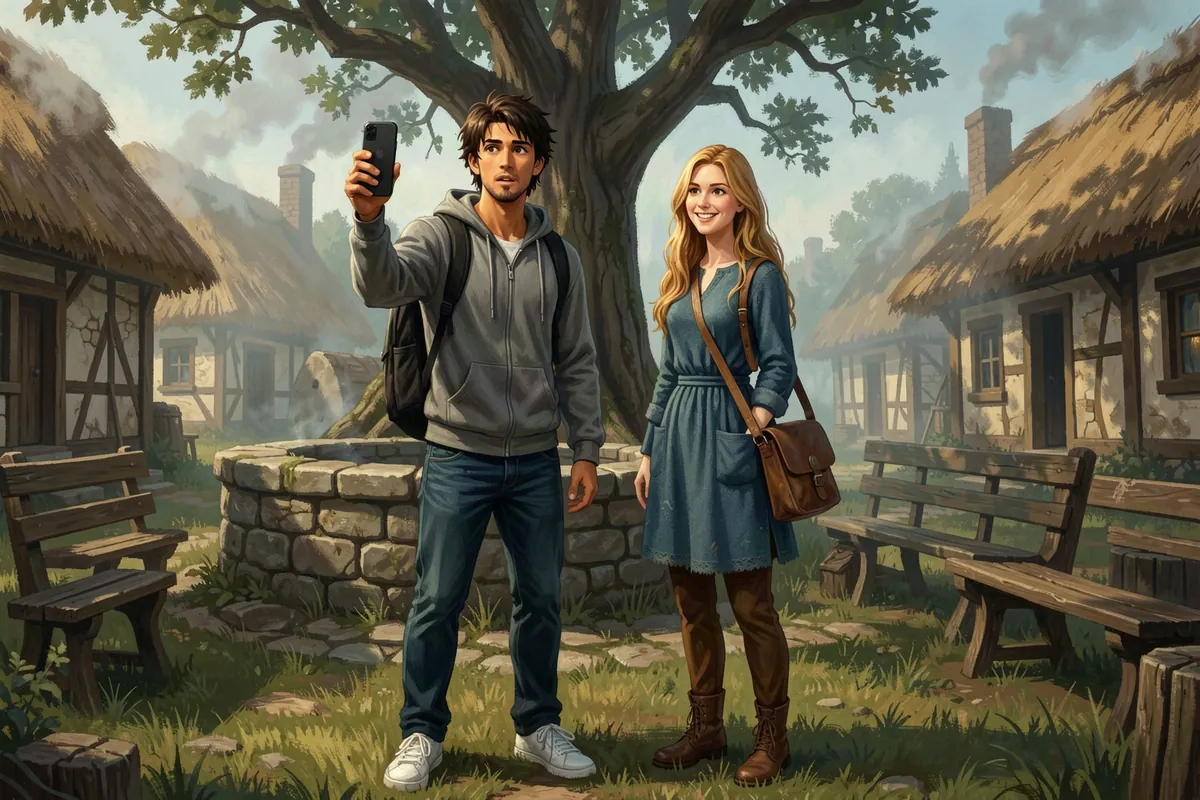
A newcomer's first morning in Emberhollow, drawn in the world's art style.
The strongest isekai openings answer one question fast: what does this person know, or lack, that the locals don't? A nurse who knows about germs, a gamer who knows how the story ends, a shut-in who has never had to talk to anyone.
- For characters, see the isekai OC ideas.
- For two-person scenes, try the isekai roleplay ideas.
- For full plots with a twist, see the isekai plot ideas.
To play one instead of writing it, Mythx, the AI roleplay game we make, starts you as the newcomer who has just arrived in a small world, and the AI plays everyone you meet. The isekai AI game page shows how that works. It's free to start in your browser with no sign-up, and your first scenes come illustrated. If you've tried other AI isekai apps, our Isekai Zero alternatives list compares them.
Isekai FAQ
What does isekai mean in English? It translates as "another world" or "different world." In English it now names the genre of stories where someone from our world ends up in another one.
Is Sword Art Online an isekai? It's often called a modern pioneer of the genre, and its 2012 anime is credited with starting the boom. Its author, Reki Kawahara, disagrees that it counts (Wikipedia).
What is a reverse isekai? A story where someone from a fantasy or futuristic world comes to ours, like the Demon Lord working fast food in The Devil Is a Part-Timer!
What is truck-kun? Fans' nickname for the truck that kills the hero in so many isekai openings, sending them to the next world.
What was the first isekai? Stories of travel to other worlds go back to folk tales like Urashima Tarō. For the modern Japanese genre, Wikipedia names Warrior from Another World (1979) as the first isekai novel and Aura Battler Dunbine (1983) as the first isekai anime.