6 Best Free AI RPG Games to Play in Your Browser (Updated Sep 2026)
By Nayan Dhabarde · Published July 2, 2026 · Updated September 29, 2026
The best thing about browser AI RPG games is that the distance between "I'm curious" and "I'm playing" is about ten seconds. No installer, no launcher, no 40 GB download eating your evening. You open a tab, and an AI game master starts building a world around whatever you type.
That convenience matters more for AI RPGs than for most genres, because these games live or die on experimentation. You want to try a grim detective story, abandon it, roll a chaotic bard, abandon that too, and finally settle into the campaign that clicks. Browser play makes that churn free. It also means your game follows you across devices — start a scene on your laptop at lunch, continue on your phone that night — and almost every platform on this list lets you try it without paying anything up front.
Below are six AI RPG games and platforms you can play in a browser right now, with an honest look at what each does best and who it actually suits. One of them is ours, and we'll flag that clearly when we get there. We checked each one against its own site in September 2026.
At a glance
| Game | Best for | Free to play | Visuals | Also on phone |
|---|---|---|---|---|
| AI Dungeon | Total freedom | Yes, no action limits | Images on demand | iOS, Android |
| Mythx AI (ours) | An illustrated living world | Yes, free daily gems | Image every scene | iOS, Android |
| NovelAI | Writers who want control | Trial | Anime image generator | Browser only |
| Character.AI | Character dialogue | Yes, with ads | Image generator | iOS, Android |
| Friends & Fables | Real D&D 5e rules | 25 turns a day | On demand, battlemaps | Browser only |
| Hidden Door | Playing inside a story world | Yes, up to 5 worlds | Story art | Browser only |
AI Dungeon
AI Dungeon is the game that put AI text adventures on the map. It works like a classic text RPG with the guardrails removed: you type actions ("do"), speech ("say"), or narration ("story"), and the AI continues the tale in whatever direction you push it. There are pre-built scenarios and worlds, but the real draw has always been total freedom — you can attempt literally anything, and the AI will try to make it coherent.
What it does best: Raw open-endedness. No other game on this list is quite as willing to follow you off the rails, and its scenario library, built up over years of community creations, is enormous.
Who it suits: Players who value freedom over structure and don't mind occasional AI weirdness — forgotten details, tonal swerves — as the price of a game that never says "you can't do that." The free tier has no action limits; paid plans ($14.99 to $99.99 a month) unlock stronger models and a longer memory. It can also make images, short video and voice narration on request, paid for with credits.
Mythx AI
Full disclosure: this is our app, so weigh this entry accordingly. Mythx AI is an AI RPG that plays free in the browser with no credit card required, and its focus is making AI adventures visual and persistent rather than just textual.
Every scene you play gets an instant AI-generated image, and — the part we sweat over most — your characters stay visually consistent from scene to scene, so your companion actually looks like the same person in scene 40 as in scene 1. You arrive as the newcomer in one of our living worlds — a cozy fantasy village, Victorian London, a magic academy, a fantasy tavern you inherit, and more — with a cast, places and relationships already in place, which means NPCs aren't props: you can talk to any of them, and they remember what you've said and react accordingly. If you enjoy AI roleplay where conversations with NPCs carry real weight, that persistence is the core of the experience.
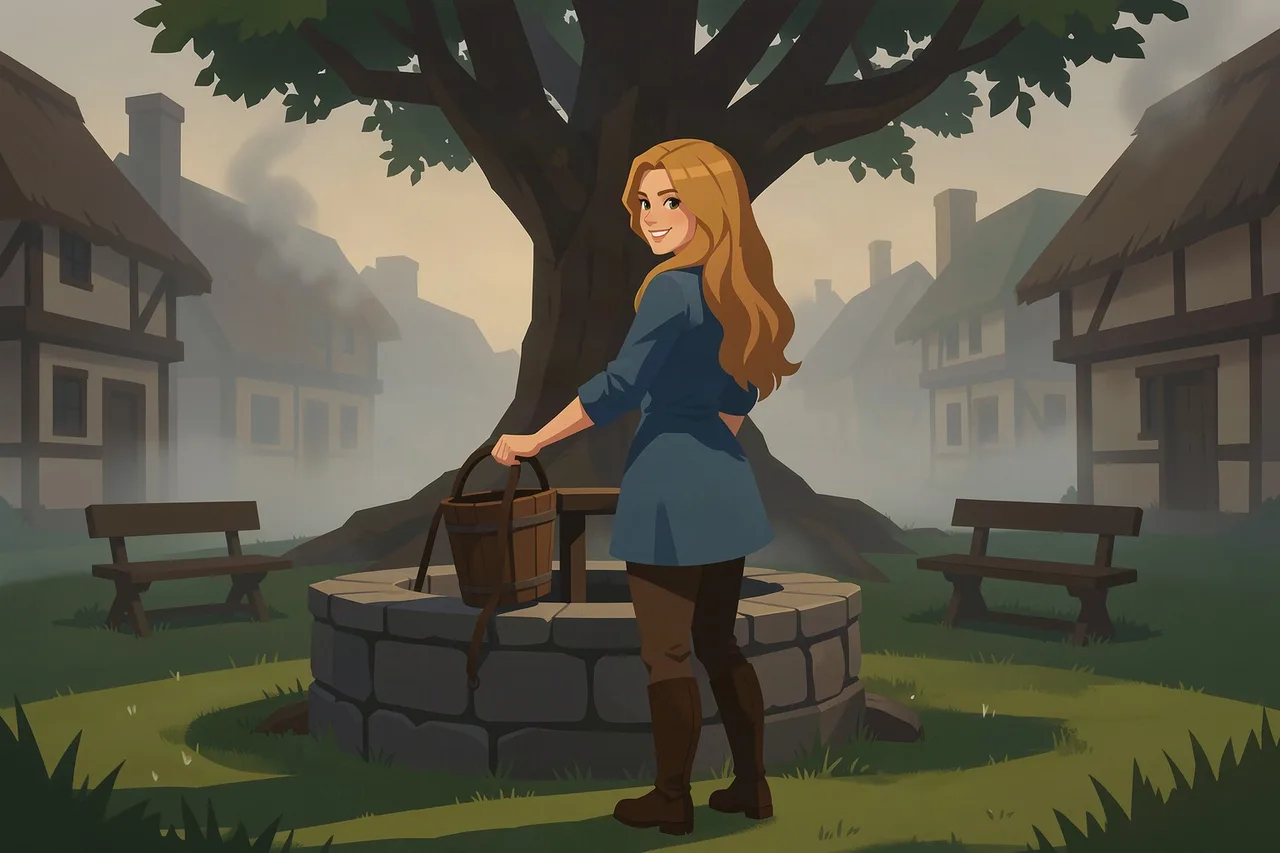
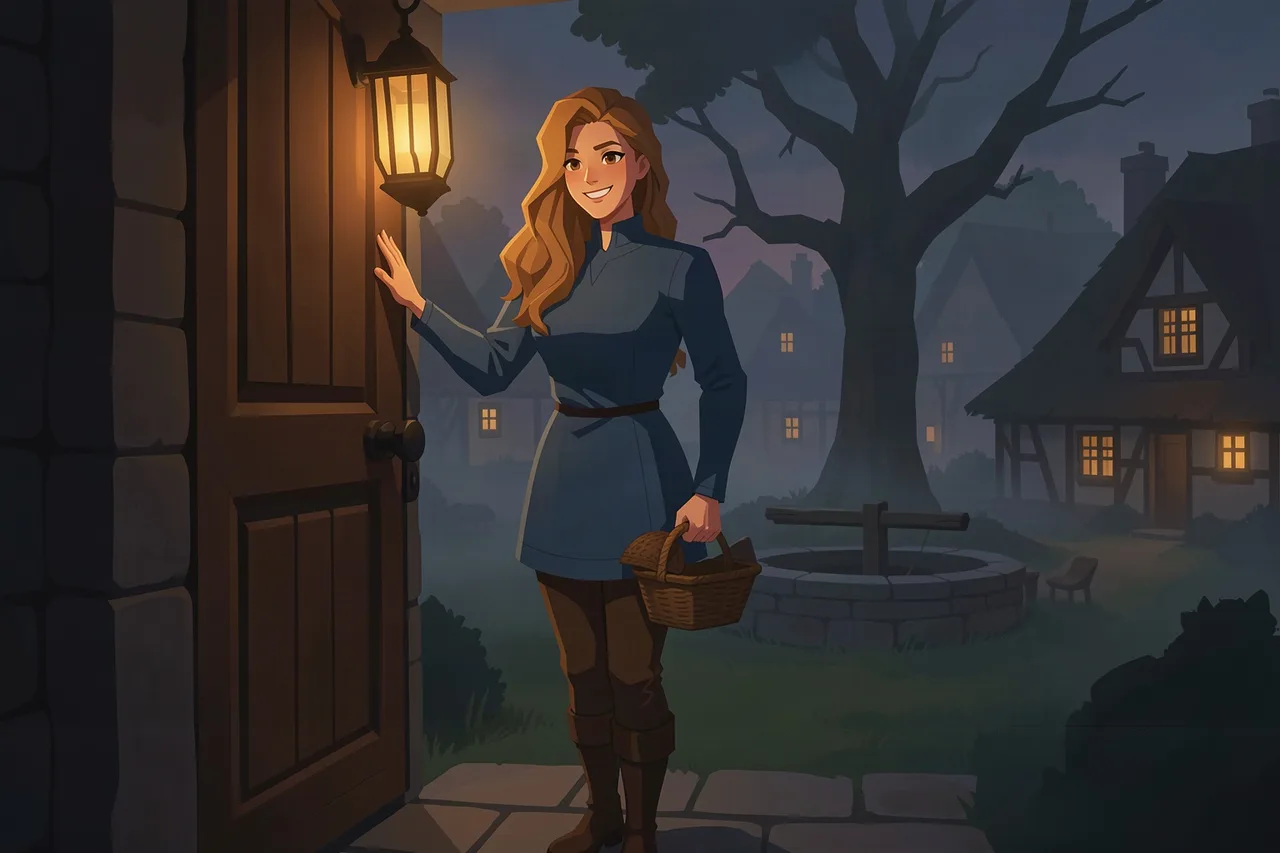

The same companion across a full in-game day — morning at the well, dusk at your door, night at the inn.
What it does best: Visual continuity and living worlds. Seeing a consistent, illustrated version of your story changes how attached you get to it.
Who it suits: Players who want more than a wall of text — something closer to an illustrated campaign — without setup work. It runs in the browser and is also on iOS and Android, so a story started at a desk continues on the couch. If anime is your lane, every Mythx adventure also plays as an isekai AI game — you arrive as the outsider in a world that already exists, with anime art styles built in. It's free to start with free gems every day; Premium is $9.99 a month for unlimited story and 100 illustrated scenes a day. You can dig into the details on our features page. The trade-off: it's narrative play, with no dice or character sheets.
NovelAI (Text Adventure mode)
NovelAI is primarily an AI-assisted writing tool, but its Text Adventure mode turns it into a capable second-person RPG in the AI Dungeon mold: do/say/story inputs, AI narration in response. What sets it apart is control. Lorebooks let you define characters, places, and factions that the AI reliably remembers; memory and author's-note fields let you steer tone and plot at a level most AI games don't expose.
What it does best: Consistency through configuration. If you're willing to write lorebook entries, NovelAI keeps long stories more coherent than almost anything else, and it also offers image generation as a separate feature for visualizing characters.
Who it suits: Tinkerers and writer-types who enjoy world-building as much as playing. It's a subscription product from $10 a month, with a free trial (no credit card) rather than a lasting free tier — so it's a better fit once you know you like the genre.
Character.AI
Character.AI isn't an RPG in the dice-and-inventory sense; it's AI roleplay chat. You pick (or create) a character — a rival swordmaster, a ship's AI, an entire "RPG game master" persona — and have an open-ended conversation with them. Community-made characters number in the millions, and many are explicitly built as adventure or dungeon-master bots that will run a lightweight campaign inside the chat.
What it does best: Character voice. The personas are expressive and distinct, and the barrier to entry is as low as it gets: open the site, pick a character, start typing. The core experience is free with ads; paid lite and c.ai+ plans cut the ads and slow mode and add more memory.
Who it suits: Players who care more about relationships and dialogue than mechanics. If your favorite part of an RPG is the conversation with the mysterious stranger rather than the fight afterward, start here. The trade-off is structure — memory pins and a Lorebook help it remember, but there are no stats or inventory, it's strictly filtered, and long sessions can drift.
Friends & Fables
Friends & Fables aims squarely at the tabletop crowd: it's a D&D 5e AI RPG where an AI game master (named Franz) runs a campaign with actual mechanics underneath — character sheets, dice rolls, combat, battlemaps — rather than pure freeform narration. It runs in the browser, supports parties of up to six where only the host pays, and has the deepest world-building tools in the genre.
What it does best: Marrying AI narration to real rules. When the AI GM calls for a roll and your stats matter, outcomes feel earned in a way freeform text games can't quite match.
Who it suits: D&D players who can't get a group scheduled, or anyone who wants crunch with their story. The free tier gives you 25 turns a day, with paid plans from $19.95 a month. Worth knowing: its team paused big new updates until 2027 to focus on a new product. If freeform is your preference, this will feel comparatively constrained — that structure is the point. See our Friends & Fables alternatives if it isn't quite right.
Hidden Door
Hidden Door takes a different angle: story games set inside curated worlds — licensed ones like The Crow and Call of Cthulhu, public-domain classics, and originals — where human-written story beats keep the AI consistent with that world's tone and rules, with dice rolls for risky actions. Anyone can sign up now: the free plan gives unlimited stories and turns a day in up to five worlds, and its Atlas tool lets players build and share their own worlds. It runs in the browser.
What it does best: Tone discipline. Because each world is curated, the AI stays on-genre far more reliably than open sandboxes do.
Who it suits: Readers first, gamers second — people whose dream isn't "infinite anything" but "let me actually walk around in that book."
What to Look For in an AI RPG
Whichever way you lean, four things separate a great AI RPG from a frustrating one:
- Memory. The single biggest quality factor. Does the game remember your companion's name, your promises, that you burned down the tavern? Look for platforms with persistent character memory or player-editable lorebooks; short-memory games unravel after an hour.
- Image generation. Text-only is fine, but visuals raise the stakes — if they're consistent. A portrait that changes faces every scene breaks immersion faster than no portrait at all. Ask whether images are instant and whether characters stay recognizable.
- Freedom of action. Can you attempt anything, or are you picking from options? Neither is wrong — freeform rewards creativity, structure rewards it feeling like a game — but know which you want before you commit to a subscription.
- Pricing model. Most platforms here are free to start, then meter the good stuff (better models, longer memory, more images) behind subscriptions or credits. Exhaust the free tier before paying, and check what the free experience actually includes as of when you're reading — these details change often.
One more practical tip: come in with a premise. Every game on this list is dramatically better when you arrive with a character concept and a hook instead of "uh, fantasy, I guess." If you're staring at a blank prompt, run your idea through a plot generator first and walk into your chosen game with a story worth telling.
The genre is moving fast — memory windows keep growing, images keep getting more consistent, and the gap between "chatbot with dice" and "living world" narrows every few months. The good news is that trying any of these costs you nothing but a browser tab. Open a few, throw the same character concept at each, and see which world pulls you in.